





Solon Springs, Wis. — Residents of “wolf country” in Douglas County and the surrounding area met in Solon Springs Feb. 18 at a listening session coordinated by the Wisconsin Wildlife Federation (WWF) and Wisconsin Association of Sporting Dogs.
Pat Quaintance, of Bayfield, serves as president of both groups. He opened the session by telling participants their comments would be recorded and forwarded on to the DNR as part of a public comment period on the DNR’s draft wolf plan. Earlier, the WWF had filed 32 objections of the plan with the DNR, but also wanted input from those who deal with wolf issues on a daily basis.
Most of the attendees were hunters and trappers from the northwestern part of Wisconsin, but there were also several farmers who came to speak. There were more than 60 people in attendance. Many said they had told others of the meeting, only to get the response, “Who cares. Nothing ever gets done anyway.”
RELATED COMMENTARY:
Wisconsin DNR wolf plan mirrors others here and near
Report from Wisconsin Wildlife Federation wolf meeting
The meeting did draw the attention of lawmakers, the DNR and the Natural Resources Board (NRB). Representatives from these entities came to listen and to learn first-hand of issues wolf country residents see.

Republican Chanz Green, the 74th Assembly District representative, spoke, letting hunters and farmers know one of the reasons he ran for Assembly was to represent sportsmen on such issues. A bear hunter himself, Green said he understands wolf impacts and that those issues would not lessen without intervention and management.
“I want to thank you guys for putting this on, because this is how we get things started. We need to speak up,” Green said.
Green mentioned U.S. Rep. Tom Tiffany’s, R-Wis., recent proposed legislation to federally delist wolves once and for all and asked those in attendance to support Tiffany’s effort. Green said a Feb. 15 deer management hearing by the Assembly Committee on Sporting Heritage showed that, although deer hunting is a $2.3 million industry, wolf depredation – and the overall predator load in general – was not being taken into account.
“Legislation is happening, but we need to be louder,” Green said. “You need to be respectful, you know. Kill them with kindness, but let them know that we need to manage our wolves.”
Mark Liebaert, Douglas County Board chairman, said the county board had passed a resolution, as have many other counties, demanding the DNR set a population goal of 350 wolves or less.
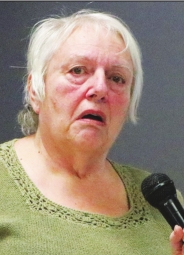
Almost every member of the board who lived in the county, he said, had a story to tell about wolf conflicts or harassment. Wolf kills were reported by all farmers who attended the annual meeting in the county, he said.
“We have farmers who are not here today because they have given up asking the Natural Resources Board or the DNR to do anything,” he said. “It’s too bad that’s where we’re at.”
Newly appointed DNR Secretary Adam Payne attended the meeting via Zoom. The WWF’s Laurie Groskopf, of Tomahawk, said many DNR employees were invited to attend in person, but none of them did.
Many hunters who spoke had years, or even decades, of experience in the woods. As wolf populations have grown, they said, deer numbers have shrunk, and in many cases, are now almost non-existent in places with historically healthy populations. Where there are still some deer, the large bucks are absent.

Several hunters said they no longer felt comfortable walking out of the woods at night. Even bowhunters said they would not walk out of the woods in the night without a firearm of some sort. There were many stories of wolves approaching humans, showing little fear.
There were stories of the noticeable lack of deer versus a decade ago. Many hunters came forward to say they were now contemplating selling their hunting land as they are seeing far more wolf tracks than deer tracks, as well as seeing areas abandoned that were once deer wintering yards.
If they wished to harvest deer – and to allow their children and grandchildren an opportunity to do the same – they would have to hunt in other areas of the state.
The expanded buffer zones around reservations included in the plan were an issue for many, as well. Quaintance was the first of many to speak to this topic. His property is within one of the sub-zones. His property is affected by three wolf packs. He has photographs of wolves within 50 yards of his house, as well as his son’s house.
The DNR calls the sub-zones in question buffer areas around the reservations in the ceded territory. In those zones, wolf harvest would be strictly limited. However, the zones are much larger than the six-mile radius originally planned. Quaintance said the buffer zone in his area would now be approximately 17 to 18 square miles.
There is a lot of private land located within the buffer zones. Those landowners would not have the same harvest opportunities as those outside of that zone.
Quaintance said this not only takes away his rights as a property owner, but also would put him at a disadvantage when needing to control wolf populations locally.
Quaintance spoke about livestock losses that have happened around his house in recent years. The Echo Valley Pack has been determined to have killed one hound, as well.
All who spoke agreed that wolves have a place on the landscape. However, when wolves and humans are in close proximity, problems become more frequent.
Groskopf spoke to the group about what she called the “expansionist” wolf management plan.
The original number of wolves for federal delisting in Wisconsin came from a series of studies by the University of Wisconsin, she said, that looked at the carrying capacity of wolves in prime areas of the state.
Prime areas would be those with plenty of game to eat and low human presence. Based on that research, Wisconsin determined that 50 wolves would be the threshold to move the species from endangered to threatened, with 250 as the threshold at which wolves could be considered recovered.
The social carrying capacity in the 1999 wolf plan was seen as 350 in prime wolf area, she said. The proposed zones are based on the fact that wolves have shown up in certain areas, rather than whether or not these areas are appropriate for wolves.
“Expansion of wolves in western states have become a real problem, as we believe they have in the Midwest, too,” she said.
Once the carrying capacity of acceptable wolf habitat was reached, the wolves had to go somewhere or die, she said. Later studies showed that wolves were occupying secondary range at a higher rate than when there were fewer wolves in the state.
“At the end of his study, (the researcher says), and I’m paraphrasing, obviously, I’m not quoting directly, ‘Just because they are living there does not mean it’s a good idea that they are living there,’” she said.
Jim Soyring was one of numerous farmers to speak. He owns a beef farm in Douglas County with about 200 cattle.
“Every year we have 15, 20, 30 calves killed by wolves,” Soyring said. “The compensation is only 70% of what the calf is valued at. I think people who want wolves around should pay the bill.”
The losses go much higher than dead cows or calves, he said. Fencing, herd health, and other issues caused by wolf harassment and depredations all add to the total bill.
Pennsylvania’s hunting license sales down so far this year
Hunting license sales are down nearly 4.5% at the end of August, although Pennsylvania Game Commission officials believe there is

Origin of road-killed armadillo in southwest Ohio a mystery
An armadillo found as roadkill in southwest Ohio has researchers scratching their collective heads wondering from where the non-native mammal
Bowhunt gets started in Ohio with additional opportunity in CWD surveillance area
Hunters in Ohio’s chronic wasting disease (CWD) surveillance area have additional dates this season to pursue white-tailed deer. The Ohio
