TROUT FISHING: OHIO
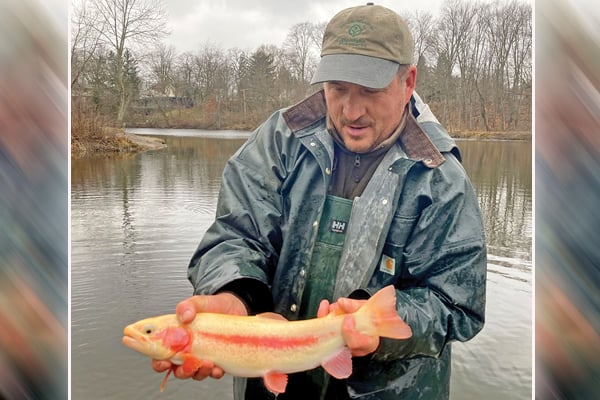
A fair amount of trout fishing occurs in the spring, much of the activity in occurring in lakes. Rivers offer opportunity in the winter. Flowing water is the last to freeze. We have but a few rivers with trout, but they are good ones.
River trout provide some of the memories that smallmouth bass do. I have to go to a beautiful surrounding to find them. Not just any river, one spring fed with cool groundwater, picturesque places I may overlook for other reasons. Trout rivers are the places I want to spend the day.
Tackle
There are many options for the line.
Braid to a leader of monofilament or fluorocarbon, mono to fluoro, straight mono or fluoro. The goal being a leader that is light or invisible. Some use 2-pound test. Fluorocarbon gives more freedom to use heavier line. I use straight 6-pound mono with 1⁄32- to 1⁄16-ounce jigs.
If fly tackle interests you, a 5-weight rod, of 8 to 9 feet, should do. Yes, lighter rods can work, but a 5-weight is general purpose, covering the heaviness needed to probe faster runs and deeper holes without taking from the quality of the experience.
Leaders appropriate for the fly sizes make decisions easier. Keep in mind the possible need for additional weight when approaching deep runs. I value presentation over tackle. I use a loop knot to give the presentation more natural action. A fly or bait dragged downstream is not an easy sell to seasoned trout. They are holdovers from spring and by this time they have seen it all. The endless procession. Yours has to be better than the rest. A discrete leader and drag-free drift cannot be overdone.
With few exceptions, I need some amount of weight in the form of a split shot, a jighead, or a weighted fly to reach the strike zone. There will be times when a spinner or spoon will do nicely. You just never know what works until you try.
Bait
Depth adjustments with live bait and synthetic bait can be made with a bobber, strike indicator, split shot, or sinker. I use the smallest bobber possible, an inch in size at most, to reduce the impact when cast. Less resistance from buoyancy is key. Trout become adept at dropping immediately without getting hooked.
Red worms, wax worms, and maggots (spikes) do nicely on small jigs and single hooks. Add more than one worm or combine them if you wish. A great way to increase attraction is tipping one bait with another, such as adding a processed salmon egg to a swimbait. Adding an egg or wax worm to a synthetic worm hooked sideways is another option.
Synthetic bait may float. Not all brands do. Berkley Gulp Pinched Crawler is a synthetic bait available in floating and non-floating versions. The hook size will determine whether a bait will ultimately float. I cut the 2-inch size in half, and thread it on the hook. The 1-inch size does not need to be cut. Bubble gum (pink) or chunk cheese (yellow) are stand out colors that may work with tough trout. You may have to order them online. Store artificials in a glass jar after opening, to prevent dry-out. A drop or two of mineral oil, if needed, will bring them back to life.
Mad River
The Mad River in southwest Ohio originates in the buried valley aquifer, compliments of the most recent glacier. Thick layers of permeable sand and gravel store immense amounts of groundwater. It flows in at 56 degrees Fahrenheit, all year long.
Five public fishing areas await, from Zanesfield to the north downstream to Urbana.
Mohican
The Clear Fork branch of the Mohican River flows near Loudonville. Mohican State Park provides generous access below the Pleasant Hill Reservoir dam. Access upstream of Pleasant Hill lies between the Cutnaw Road and Snoffer Road bridges.
Clear Creek
The Clear Creek Metro Park at Rockbridge contains 5,300 acres of sandstone cliffs and ravines, including the last remaining colonies of rhododendron and the largest state nature preserve. Access to Clear Creek home is available along Clear Creek Road.