Blair County, Pennsylvania turtle is likely 130 years old
Grazierville, Pa. — Joshua McCaulley, of Grazierville, Blair County, is an average fellow in many ways, but one thing that sets him apart from the crowd is his interest in and love for reptiles and amphibians.
He has been extremely curious about reptiles and amphibians since he found a garter snake when he was 10 years old. His study and interest qualifies him as an amateur herpetologist.
“I’m a ‘herper,’” McCaulley said. “I stop my car every time I see a turtle, snake, frog or toad trying to cross the road.” He helps them move safely to the other side.
“I was soon interested in other snakes, snappers and wood turtles – I just haven’t stopped,” McCaulley added.
On April 17, McCaulley was driving home from his work with C & L Lawn Care, when he spotted a turtle just sitting in the middle of Bell Hollow Road – in Taylor Township, Centre County. Of course, he stopped to check on the stationary reptile.
“I have come across hundreds of snakes and turtles and everything in between in the reptile and amphibian world, but this particular turtle – an eastern box turtle – was different,” he explained. “He was slow and appeared to be sick.
“I turned it over to look more closely and determine its sex,” McCaulley continued. “It was a male, and much to my surprise, in the middle of his shell were four numbers engraved – they read 1878.”
Since McCaulley had previously found several turtles with engravings only going back a few years at most, he realized upon seeing the date that this turtle was not sick – he was just very, very old – well over 100 years.
McCaulley, a 2007 graduate of Tyrone Area High School, decided to take the turtle home to evaluate its health. Since he already keeps several captive-bred snakes and turtles as pets, he knew how to care for the aging box turtle.
“The turtle ate fine and he wasn’t as afraid of humans as most box turtles. He didn’t close up his shell,” McCaulley explained. “However, I only saw him open his eyes once.”
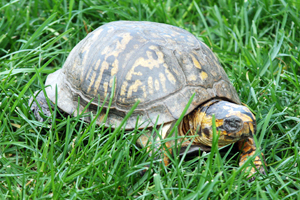
The eastern box turtle (Terrapene carolina carolina) is one of Pennsylvania’s most common terrestrial turtles. It has a high-domed shell that is usually brown and decorated with orange or yellow markings.
This species is the only central Pennsylvania turtle with a hinged plastron (the underside of the shell).
The easiest way to identify a box turtle is by picking one up. When danger threatens, its head and legs can be completely hidden when the double-hinged shell closes, often accompanied by a very noticeable hissing sound.
This feature is what McCaulley was referring to when he said that “he didn’t close up his shell.”
A gray squirrel or cottontail rabbit would be lucky to see its second birthday. A white-tailed deer is very old at age 10, and a rare black bear lives to 20. However, box turtles can have a long lifespan, although no one knows exactly how long.
Many box turtles live to 40 or 50 years, and a few have been reported to be over 100. Assuming that this turtle was 20 (nearly full-sized) when the date was carved, could McCaulley’s find really be 150 or more years old?
According to the Smithsonian National Zoological Park’s website and other credible sources, box turtles can live more than 100 years. For example, an eastern box turtle that was believed to be 130 years old was found in Illinois.
The turtle’s shell or carapace is made up of smaller living pieces called scutes. The scutes have growth rings just like trees; however, evidence suggests that the number of rings on a turtle’s scutes will not provide an exact age estimate. You can probably count the rings (annuli) to get a good idea of a young turtle’s age, but after 15 years, the older rings are often worn smooth.
Box turtles grow at an average rate of just over a third of an inch a year, and they attain a shell length of about 6 inches in 18 to 20 years.
McCaulley’s turtle measured 5.25 inches, but all of the growth rings were gone – worn totally smooth.
Retired Clarion University biologist Dr. William Belzer – the leader of an effort to save box turtles – examined photos of McCaulley’s find.
“The view of his carapace with the rings all worn smooth adds credence to the date carved into the plastron,” Belzer said in an email. “Although we can’t know for sure, this turtle could be an ultra-centenarian.”
Dr. C. Kenneth Dodd, a renowned box turtle expert with the University of Florida and author of “North American Box Turtles – a Natural History,” offered his opinion.
“… 1878 seems reasonable, especially considering the [way that the carapace looks]. I have seen only a very few such turtles (box turtles and gopher tortoises) that look like this,” he said.
“I suspect this is indeed a very old turtle that somehow has survived the onslaught of man ... The [appearance] of the date – no extensive spacing between the numbers and a similar height among numbers – suggests it was marked after the turtle reached maturity.
If it was small when marked, I would expect to see mark-migration and differences in number size.
“I cannot guarantee this turtle was marked in 1878, but it could have been,” Dodd wrote after viewing the photographs of the turtle.
Ohio naturalist, biologist, artist and author Julie Zickefoose was amazed at McCaulley’s find.
“Holy cow! Those worn scutes tell the tale almost as well as the date. This blows my mind,” she said. “He [the turtle] was probably just a little foggy from the winter sleep. When I think of the land-use changes that turtle has weathered in the last century, I just shake my head.”
Experts suggest that it is usually better not to remove a turtle from the wild. If picked up, they advise returning turtles to the exact spot of capture as soon as possible.
Research suggests that because of their small home range, turtles released in strange areas may become disoriented and unable to locate enough food or a suitable hibernation site.
Following correct conservation practice, McCaulley’s turtle was returned to near where he had found it so that it could continue its life path.
“McCaulley’s find is certainly a valuable addition to the scant evidence of how old box turtles can actually get,” Belzer said.
It is amazing to think that living in central Pennsylvania is a box turtle who likely started his life during the Civil War. It could be the oldest eastern box turtle ever recorded.
Email
Print