


Michigan Mixed Bag: Officials renew venison warning for deer taken near Clark’s Marsh

Lansing — Michigan health and wildlife officials are reminding hunters not to eat venison from deer harvested within three miles of Clark’s Marsh in Oscoda Township because of potential chemical contamination.
The Michigan Department of Health and Human Services and Michigan DNR issued the reminder based on testing that found elevated levels of per- and polyfluoroalkyl substances (PFAS) in deer from the area. Testing detected perfluorooctane sulfonic acid (PFOS), a type of PFAS, in both the liver and muscle tissue of deer harvested near the marsh. Exposure to PFOS has been associated with health concerns including liver damage, increased cholesterol and reduced fertility.
The deer consumption advisory was first established in 2018 and updated in 2019 and 2021. The latest update reduced the restricted area from five miles to three miles around Clark’s Marsh.
The warning is part of several environmental health advisories affecting the area. A do-not-eat fish advisory has been in place at Clark’s Marsh since 2012. In 2019, officials also issued restrictions covering resident aquatic and semi-aquatic wildlife, including muskrats, frogs, turtles, snails and crayfish.
State health officials additionally recommend avoiding consumption of organs from fish, deer and other wild game harvested anywhere in Michigan because contaminants such as PFAS can accumulate in those tissues.
MORE COVERAGE FROM MICHIGAN OUTDOOR NEWS:
Ralph Loos: A new Michigan governor, a new opportunity for the outdoors
Whitefish egg collection in Michigan comes with purpose
Michigan survey of bats finds signs of recovery
MDARD, MISP to Recommend Five Invasive Plant Species for Regulation in Michigan
Lansing — The Michigan Invasive Species Program (MISP) plans to recommend five additional plant species for regulation under the Natural Resources and Environmental Protection Act. MISP staff was scheduled to present the recommendations at the Michigan Commission of Agriculture and Rural Development meeting on Nov. 17. If MCARD approves advancing the recommendations to public comment, the MISP will announce the start of a 30-day public comment period.
The draft order, a public comment form and additional information will be posted on the MISP website.
Proposed prohibited species are creeping water-primrose and large-flowered water-primrose. Proposed restricted species are round-leaved bittersweet, lesser celandine and common butterbur.
Prohibited species are not widely established in Michigan, while restricted species are already established within the state.
MISP will also present the recommendations for discussion at the Natural Resources Commission meeting on Dec. 9.
Clean Boats, Clean Waters Offering Grants
Lansing — Provided by Michigan Clean Boats, Clean Waters, grants of up to $3,000 are available to organizations communicating aquatic invasive species prevention information through outreach materials and in-person educational events aimed at the boating and angling community.
The application period is open through Jan. 31, 2027, with $35,000 available for this grant cycle.
Grant projects should be focused on the outreach and prevention pathways for aquatic invasive species. Funds can be used for a variety of activities, including printing and installing signage, invasive species removal tools, educational swag or handouts, or materials for educational booths or presentations.
Further information and a grant application can be found on the Clean Boats, Clean Waters grant webpage. Questions about the Clean Boats, Clean Waters program can be directed to Kelsey Bockelman, Bockelm4@msu.edu.
4-Wheel Drive Group Receives Land Use Award
Lansing — The Great Lakes Four Wheel Drive Association, a Michigan off-road group founded in 1969, received the Bob Ham Land Use Award from the Off-Road Motorsports Hall of Fame on Nov. 1 at a gala dinner in Las Vegas.
Each year the Off-Road Motorsports Hall of Fame sets aside a percentage of donations received to contribute back to the off-road community in the form of a land use donation. Tom Craig, president of the association, accepted the award on its behalf.
According to the association, Michigan has more than 4,000 miles of designated off-road vehicle routes and trails, nearly 12,000 miles of state forest roads and nearly 8,000 additional miles of National Forest roads that are open to off-road vehicle use. The association said 57 years of advocacy for motorized recreation access helped preserve and build that network.
“We did not inherit these trails and roads just to enjoy them. We inherited a responsibility to protect them,” Craig said. “And we intend to leave them open for the generations who follow us.”
Public Comments Sought on 2026 Michigan State Forest Road Inventory Review
Plymouth, Minn. —The Michigan DNR’s 2026 state forest road inventory review includes proposed additions, closures and mapping corrections designed to reflect current conditions, address resource protection needs and maintain appropriate access for recreation. The annual review also provides an opportunity to incorporate feedback from the public and DNR staff who use and manage these roads.
DNR encourages the public to review the proposed updates and submit comments by Dec. 1. They can do so by visiting Michigan.gov/ForestRoads to explore the interactive map or download printable PDFs of the proposed updates.
Comments can be sent to DNR-RoadInventoryProject@Michigan.gov.
SUBSCRIBER CONTENT
Read this article now.
Create a free Outdoor News account.
Create a free account below to get instant access to this article, thousands of Outdoor News stories, and our digital editions. Your 1-month trial starts the moment you sign up.
No credit card required
No credit card required
No credit card required
Subscriber? Login Here.
Share on Social
- Tags: Hunting, Invasive species, Michigan, Nature, Whitetail
Hand-Picked For You
Michigan biologists investigate why 27 lake sturgeon got trapped
Michigan Letters to the Editor: Residents deserve invasive carp transparency
Ralph Loos: A new Michigan governor, a new opportunity for the outdoors
Pleasant Hill Lake known for its saugeyes and smallies in central Ohio
Ohio’s Outdoor Calendar
Ohio Cuffs & Collars: Four defendants plead guilty to multiple turkey violations
Related Articles
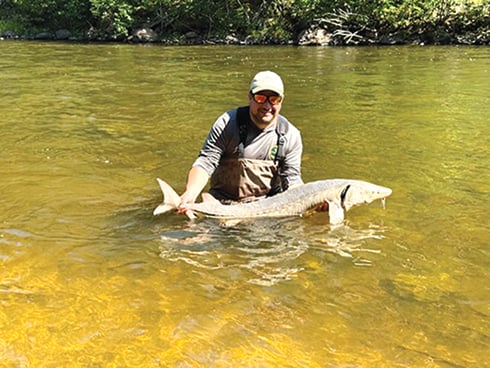
Michigan biologists investigate why 27 lake sturgeon got trapped
Lansing — Fisheries officials are embarking on a three-year project to understand why nearly 30 threatened lake sturgeon became trapped

Michigan Letters to the Editor: Residents deserve invasive carp transparency
Reader-submitted letters to the editor published in the Nov. 20, 2026 edition of Michigan Outdoor News.
Ralph Loos: A new Michigan governor, a new opportunity for the outdoors
Michigan chose its next governor, and now hunters, fishermen and everyone who enjoys the outdoors are asking what that choice
