


Editor’s note: Jack London (1876-1916) was an American novelist, journalist and adventurer best known for his wilderness classics The Call of the Wild and White Fang. His experiences during the Klondike Gold Rush of 1897-98 inspired some of his most memorable fiction, including this short story, “To Build a Fire.”
A prolific writer whose work often explored the struggle between humanity and nature, London became one of the most popular American authors of the early 20th century. His unflinching portrayal of survival continues to resonate with outdoors enthusiasts 100-plus years after his death.
In “To Build A Fire,” set within the unforgiving cold of the Yukon wilderness, a lone traveler and a dog confront a landscape where a minor mistake means a fight for survival. London’s tale delivers a chilling reminder that nature is indifferent to human confidence and ambition.
Outdoor News presents the story in two parts beginning in this edition.
Day had broken cold and grey, exceedingly cold and grey, when the man turned aside from the main Yukon trail and climbed the high earth bank, where a dim and little-traveled trail led eastward through the fat spruce timberland. It was a steep bank, and he paused for breath at the top, excusing the act to himself by looking at his watch. It was 9 o’clock. There was no sun nor hint of sun, though there was not a cloud in the sky. It was a clear day, and yet there seemed an intangible pall over the face of things, a subtle gloom that made the day dark, and that was due to the absence of sun. This fact did not worry the man. He was used to the lack of sun. It had been days since he had seen the sun, and he knew that a few more days must pass before that cheerful orb, due south, would just peep above the skyline and dip immediately from view.
The man flung a look back along the way he had come. The Yukon lay a mile wide and hidden under three feet of ice. On top of this ice were as many feet of snow. It was all pure white, rolling in gentle undulations where the ice jams of the freeze-up had formed. North and south, as far as his eye could see, it was unbroken white, save for a dark hairline that curved and twisted from around the spruce-covered island to the south, and that curved and twisted away into the north, where it disappeared behind another spruce-covered island. This dark hairline was the trail – the main trail – that led south 500 miles to the Chilcoot Pass, Dyea, and salt water; and that led north 70 miles to Dawson, and still on to the north 1,000 miles to Nulato, and finally to St. Michael on Bering Sea, 1,000 miles and half a thousand more.
But all this – the mysterious, far-reaching hairline trail, the absence of sun from the sky, the tremendous cold, and the strangeness and weirdness of it all – made no impression on the man. It was not because he was long used to it. He was a newcomer in the land, a Chechaquo, and this was his first winter. The trouble with him was that he was without imagination. He was quick and alert in the things of life, but only in the things, and not in their significances. Fifty degrees below zero meant 80-odd degrees of frost. Such a fact impressed him as being cold and uncomfortable, and that was all. It did not lead him to meditate upon his frailty as a creature of temperature, and upon man’s frailty in general, able only to live within certain narrow limits of heat and cold; and from there on it did not lead him to the conjectural field of immortality and man’s place in the universe. Fifty degrees below zero stood for a bite of frost that hurt and that must be guarded against by the use of mittens, earflaps, warm moccasins, and thick socks. Fifty degrees below zero was to him just precisely 40 degrees below zero. That there should be anything more to it than that was a thought that never entered his head.

As he turned to go on, he spat speculatively. There was a sharp, explosive crackle that startled him. He spat again. And again, in the air, before it could fall to the snow, the spittle crackled. He knew that at 50-below spittle crackled on the snow, but this spittle had crackled in the air. Undoubtedly it was colder than 50 below – how much colder he did not know. But the temperature did not matter. He was bound for the old claim on the left fork of Henderson Creek, where the boys were already. They had come over across the divide from the Indian Creek country, while he had come the roundabout way to take a look at the possibilities of getting out logs in the spring from the islands in the Yukon. He would be in to camp by 6 o’clock; a bit after dark, it was true, but the boys would be there, a fire would be going, and a hot supper would be ready. As for lunch, he pressed his hand against the protruding bundle under his jacket. It was also under his shirt, wrapped up in a handkerchief and lying against the naked skin. It was the only way to keep the biscuits from freezing. He smiled agreeably to himself as he thought of those biscuits, each cut open and sopped in bacon grease, and each enclosing a generous slice of fried bacon.
He plunged in among the big spruce trees. The trail was faint. A foot of snow had fallen since the last sled had passed over, and he was glad he was without a sled, traveling light. In fact, he carried nothing but the lunch wrapped in the handkerchief. He was surprised, however, at the cold. It certainly was cold, he concluded, as he rubbed his numbed nose and cheekbones with his mittened hand. He was a warm-whiskered man, but the hair on his face did not protect the high cheekbones and the eager nose that thrust itself aggressively into the frosty air.
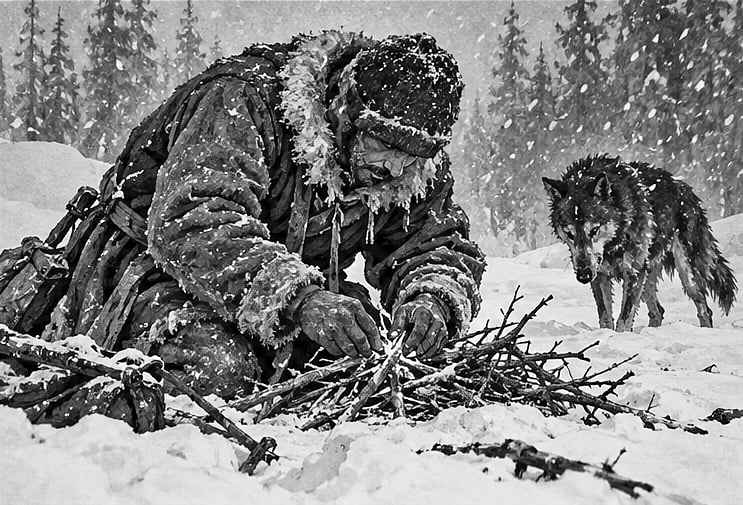
At the man’s heels trotted a dog, a big native husky, the proper wolf-dog, grey-coated and without any visible or temperamental difference from its brother, the wild wolf. The animal was depressed by the tremendous cold. It knew that it was no time for traveling. Its instinct told it a truer tale than was told to the man by the man’s judgment. In reality, it was not merely colder than 50 below zero; it was colder than 60 below, than 70 below. It was 75 below zero. Since the freezing-point is 32 above zero, it meant that 107 degrees of frost obtained.
The dog knew nothing about thermometers. Possibly in its brain there was no sharp consciousness of a condition of very cold such as was in the man’s brain. But the brute had its instinct. It experienced a vague but menacing apprehension that subdued it and made it slink along at the man’s heels, and that made it question eagerly every unwonted movement of the man as if expecting him to go into camp or to seek shelter somewhere and build a fire. The dog had learned fire, and it wanted fire, or else to burrow under the snow and cuddle its warmth away from the air.
The frozen moisture of its breathing had settled on its fur in a fine powder of frost, and especially were its jowls, muzzle, and eyelashes whitened by its crystalled breath. The man’s red beard and moustache were likewise frosted, but more solidly, the deposit taking the form of ice and increasing with every warm, moist breath he exhaled. Also, the man was chewing tobacco, and the muzzle of ice held his lips so rigidly that he was unable to clear his chin when he expelled the juice. The result was that a crystal beard of the color and solidity of amber was increasing its length on his chin. If he fell down it would shatter itself, like glass, into brittle fragments. But he did not mind the appendage. It was the penalty all tobacco chewers paid in that country, and he had been out before in two cold snaps. They had not been so cold as this, he knew, but by the spirit thermometer at Sixty Mile he knew they had been registered at 50 below and at 55.
He held on through the level stretch of woods for several miles, crossed a wide flat of boulders, and dropped down a bank to the frozen bed of a small stream. This was Henderson Creek, and he knew he was 10 miles from the forks. He looked at his watch. It was 10 o’clock. He was making four miles an hour, and he calculated that he would arrive at the forks at half-past 12. He decided to celebrate that event by eating his lunch there.
The dog dropped in again at his heels, with a tail drooping discouragement, as the man swung along the creek bed. The furrow of the old sled trail was plainly visible, but a dozen inches of snow covered the marks of the last runners. In a month no man had come up or down that silent creek. The man held steadily on. He was not much given to thinking, and just then particularly he had nothing to think about save that he would eat lunch at the forks and that at 6 o’clock he would be in camp with the boys. There was nobody to talk to and, had there been, speech would have been impossible because of the ice-muzzle on his mouth. So he continued monotonously to chew tobacco and to increase the length of his amber beard.
Once in a while, the thought reiterated itself that it was very cold and that he had never experienced such cold. As he walked along he rubbed his cheekbones and nose with the back of his mittened hand. He did this automatically, now and again changing hands. But rub as he would, the instant he stopped his cheekbones went numb, and the following instant, the end of his nose went numb. He was sure to frost his cheeks; he knew that and experienced a pang of regret that he had not devised a nose-strap of the sort Bud wore in cold snaps. Such a strap passed across the cheeks, as well, and saved them. But it didn’t matter much, after all. What were frosted cheeks? A bit painful, that was all; they were never serious.
Empty as the man’s mind was of thoughts, he was keenly observant, and he noticed the changes in the creek, the curves and bends and timber jams, and always he sharply noted where he placed his feet. Once, coming around a bend, he shied abruptly, like a startled horse, curved away from the place where he had been walking, and retreated several paces back along the trail. The creek he knew was frozen clear to the bottom – no creek could contain water in that Arctic winter – but he knew also that there were springs that bubbled out from the hillsides and ran along under the snow and on top the ice of the creek. He knew that the coldest snaps never froze these springs, and he knew likewise their danger. They were traps. They hid pools of water under the snow that might be three inches deep, or three feet. Sometimes a skin of ice half an inch thick covered them, and in turn was covered by the snow. Sometimes there were alternate layers of water and ice-skin, so that when one broke through he kept on breaking through, for a while, sometimes wetting himself to the waist.
That was why he had shied in such panic. He had felt the give under his feet and heard the crackle of a snow-hidden ice-skin. And to get his feet wet in such a temperature meant trouble and danger. At the very least it meant delay, for he would be forced to stop and build a fire, and under its protection to bare his feet while he dried his socks and moccasins. He stood and studied the creek-bed and its banks, and decided that the flow of water came from the right. He reflected awhile, rubbing his nose and cheeks, then skirted to the left, stepping gingerly and testing the footing for each step. Once clear of the danger, he took a fresh chew of tobacco and swung along at his four-mile gait.
In the course of the next two hours, he came upon several similar traps. Usually the snow above the hidden pools had a sunken, candied appearance that advertised the danger. Once again, however, he had a close call; and once, suspecting danger, he compelled the dog to go on in front. The dog did not want to go. It hung back until the man shoved it forward, and then it went quickly across the white, unbroken surface. Suddenly it broke through, floundered to one side, and got away to firmer footing. It had wet its forefeet and legs, and almost immediately the water that clung to it turned to ice. It made quick efforts to lick the ice off its legs, then dropped down in the snow and began to bite out the ice that had formed between the toes. This was a matter of instinct. To permit the ice to remain would mean sore feet. It did not know this. It merely obeyed the mysterious prompting that arose from the deep crypts of its being. But the man knew, having achieved a judgment on the subject, and he removed the mitten from his right hand and helped tear out the ice-particles. He did not expose his fingers more than a minute, and was astonished at the swift numbness that smote them. It certainly was cold. He pulled on the mitten hastily and beat the hand savagely across his chest.
At 12 o’clock, the day was at its brightest. Yet the sun was too far south on its winter journey to clear the horizon. The bulge of the earth intervened between it and Henderson Creek, where the man walked under a clear sky at noon and cast no shadow. At half-past 12, to the minute, he arrived at the forks of the creek. He was pleased at the speed he had made. If he kept it up, he would certainly be with the boys by 6. He unbuttoned his jacket and shirt and drew forth his lunch. The action consumed no more than a quarter of a minute, yet in that brief moment the numbness laid hold of the exposed fingers. He did not put the mitten on, but, instead, struck the fingers a dozen sharp smashes against his leg. Then he sat down on a snow-covered log to eat. The sting that followed upon the striking of his fingers against his leg ceased so quickly that he was startled; he had had no chance to take a bite of biscuit. He struck the fingers repeatedly and returned them to the mitten, baring the other hand for the purpose of eating. He tried to take a mouthful, but the ice-muzzle prevented. He had forgotten to build a fire and thaw out. He chuckled at his foolishness, and as he chuckled he noted the numbness creeping into the exposed fingers. Also, he noted that the stinging which had first come to his toes when he sat down was already passing away. He wondered whether the toes were warm or numb. He moved them inside the moccasins and decided that they were numbed.
He pulled the mitten on hurriedly and stood up. He was a bit frightened. He stamped up and down until the stinging returned into the feet. It certainly was cold, was his thought. That man from Sulphur Creek had spoken the truth when telling how cold it sometimes got in the country. And he had laughed at him at the time! That showed one must not be too sure of things. There was no mistake about it, it was cold. He strode up and down, stamping his feet and threshing his arms, until reassured by the returning warmth. Then he got out matches and proceeded to make a fire. From the undergrowth, where high water of the previous spring had lodged a supply of seasoned twigs, he got his firewood. Working carefully from a small beginning, he soon had a roaring fire, over which he thawed the ice from his face and in the protection of which he ate his biscuits. For the moment the cold of space was outwitted. The dog took satisfaction in the fire, stretching out close enough for warmth and far enough away to escape being singed.
When the man had finished, he filled his pipe and took his comfortable time over a smoke. Then he pulled on his mittens, settled the earflaps of his cap firmly about his ears, and took the creek trail up the left fork. The dog was disappointed and yearned back toward the fire. This man did not know cold. Possibly all the generations of his ancestry had been ignorant of cold, of real cold, of cold one hundred and seven degrees below freezing-point. But the dog knew; all its ancestry knew, and it had inherited the knowledge. And it knew that it was not good to walk abroad in such fearful cold. It was the time to lie snug in a hole in the snow and wait for a curtain of cloud to be drawn across the face of outer space from whence this cold came. On the other hand, there was keen intimacy between the dog and the man. The one was the toil-slave of the other, and the only caresses it had ever received were the caresses of the whiplash and of harsh and menacing throat-sounds that threatened the whiplash. So the dog made no effort to communicate its apprehension to the man. It was not concerned for the welfare of the man; it was for its own sake that it yearned back toward the fire. But the man whistled, and spoke to it with the sound of whiplashes, and the dog swung in at the man’s heels and followed after.
The man took a chew of tobacco and proceeded to start a new amber beard. Also, his moist breath quickly powdered with white his moustache, eyebrows, and lashes. There did not seem to be so many springs on the left fork of the Henderson, and for half an hour the man saw no signs of any. And then it happened. At a place where there were no signs, where the soft, unbroken snow seemed to advertise solidity beneath, the man broke through. It was not deep. He wetted himself half-way to the knees before he floundered out to the firm crust.
He was angry, and cursed his luck aloud. He had hoped to get into camp with the boys at six o’clock, and this would delay him an hour, for he would have to build a fire and dry out his foot gear. This was imperative at that low temperature – he knew that much; and he turned aside to the bank, which he climbed. On top, tangled in the underbrush about the trunks of several small spruce trees, was a high-water deposit of dry firewood – sticks and twigs principally, but also larger portions of seasoned branches and fine, dry, last-year’s grasses. He threw down several large pieces on top of the snow. This served for a foundation and prevented the young flame from drowning itself in the snow it otherwise would melt. The flame he got by touching a match to a small shred of birch-bark that he took from his pocket. This burned even more readily than paper. Placing it on the foundation, he fed the young flame with wisps of dry grass and with the tiniest dry twigs.
He worked slowly and carefully, keenly aware of his danger. Gradually, as the flame grew stronger, he increased the size of the twigs with which he fed it. He squatted in the snow, pulling the twigs out from their entanglement in the brush and feeding directly to the flame. He knew there must be no failure. When it is seventy-five below zero, a man must not fail in his first attempt to build a fire – that is, if his feet are wet. If his feet are dry, and he fails, he can run along the trail for half a mile and restore his circulation. But the circulation of wet and freezing feet cannot be restored by running when it is 75 below. No matter how fast he runs, the wet feet will freeze the harder.
All this the man knew. The old-timer on Sulphur Creek had told him about it the previous fall, and now he was appreciating the advice. Already all sensation had gone out of his feet. To build the fire he had been forced to remove his mittens, and the fingers had quickly gone numb. His pace of four miles an hour had kept his heart pumping blood to the surface of his body and to all the extremities. But the instant he stopped, the action of the pump eased down. The cold of space smote the unprotected tip of the planet, and he, being on that unprotected tip, received the full force of the blow. The blood of his body recoiled before it. The blood was alive, like the dog, and like the dog it wanted to hide away and cover itself up from the fearful cold. So long as he walked four miles an hour, he pumped that blood, willy-nilly, to the surface; but now it ebbed away and sank down into the recesses of his body. The extremities were the first to feel its absence. His wet feet froze the faster, and his exposed fingers numbed the faster, though they had not yet begun to freeze. Nose and cheeks were already freezing, while the skin of all his body chilled as it lost its blood.
But he was safe. Toes and nose and cheeks would be only touched by the frost, for the fire was beginning to burn with strength. He was feeding it with twigs the size of his finger. In another minute he would be able to feed it with branches the size of his wrist, and then he could remove his wet foot-gear, and, while it dried, he could keep his naked feet warm by the fire, rubbing them at first, of course, with snow. The fire was a success. He was safe.
Watch for Part 2 in the next edition of Outdoor News.
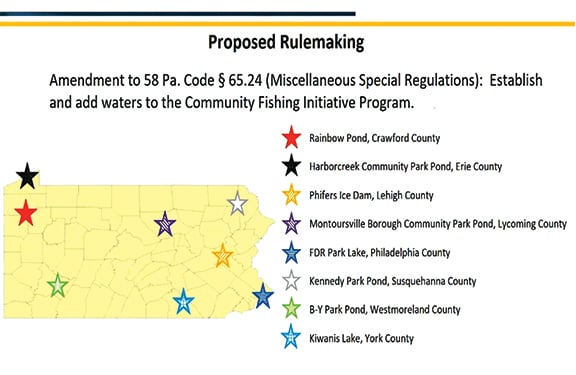
Pennsylvania Fish & Boat officers are uneasy about merging forces
Pennsylvania Fish & Boat commissioners at their quarterly meeting Oct. 26 heard complaints about how the agency was handling a
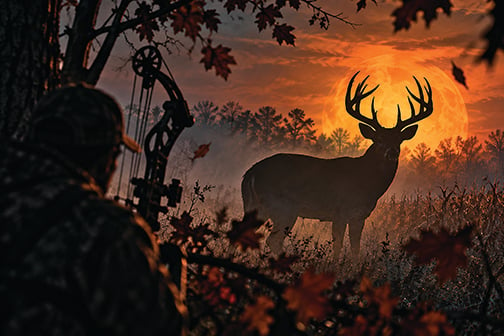
When buck fever throws you a curveball
It’s World Series season, and I love baseball – the sights, the sounds, and the culture that come with it.

Michigan Mixed Bag: Release of nearly 7,300 pheasants underway
Michigan hunters will have additional opportunities to pursue ring-necked pheasants this fall and winter as close to 7,300 birds were
