





Bucket lists – those lists of experiences, destinations, or lifetime achievements each of us carries and hopes to accomplish before our time on Earth is over – are a precious commodity.
For some, the lists are carefully curated, fine-tuned, adapted, amended, and edited. They are our motivation to grind through life’s requirements so that we can, on occasion, leave our comfort zones and do things exotic or extravagant.
I called my friend Roy on a whim in early February, curious how he fared with the annual U.S. Forest Service Boundary Waters Canoe Area Wilderness permit registration opening free-for-all. I was a little surprised when he told me he hadn’t secured any permits.
Roy had few plans for hunting or fishing trips, and he seemed a bit stuck in melancholic apathy regarding getting away on an excursion.
Not wanting Roy to feel sorry for himself and therefore make a shameful decision such as being drawn into blood-sport consolation activities such as golf or bowling, I felt an intervention was necessary. Spontaneity is a trait to be encouraged and nurtured, so that life does not become a state of rut and routine.
“Let’s get you on a bucket-list trip,” I told him. “Have you thought about chasing white sturgeon?”
He said he had not, but I certainly had. With as much assertiveness as I could muster, I informed Roy that he and I would be chasing white sturgeon later in the year, knocking another trip off the bucket list and ensuring we’d have something to anticipate and, later, look back upon.
I laid out the details. We’d fly a commercial airline, rent a small car, find a motel, then book a guide to catch the largest freshwater fish in North America. We ended the phone conversation with personal to-do lists: convince our spouses that a guy’s trip to Portland was in order, book the necessary reservations, and run for six months on the anticipation of catching fish that make Minnesota’s lake sturgeon look small by comparison.
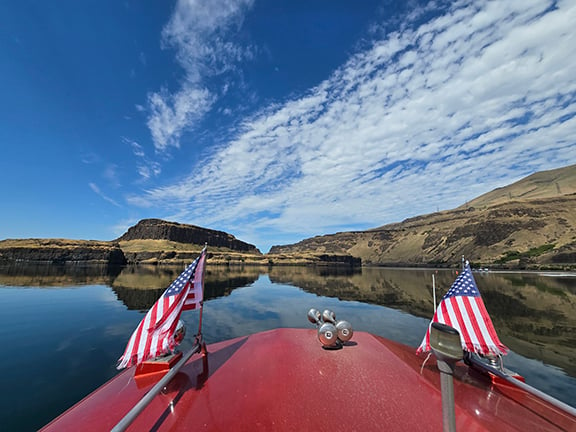
On our way
By the time our D-Day (departure) arrived, our spirits were high and the American West was locked into a heat wave.
As we stepped off the plane in Portland, the heat seeped through the accordion-style gaskets of the jet bridge as we made our way toward the terminal. We quickly picked up our shared checked bag, found our rental car, and headed east on Interstate 84.
As we drove, we traversed the Columbia Gorge, watching the Cascade Mountain range and tall pine trees slowly morph into the Columbia Plateau and its high-sided cliffs covered in cheatgrass and shrublands. After two hours of driving, we reached our destination: Rufus, Oregon. Population: 227.
MORE FISHING FEATURES FROM OUTDOOR NEWS:
Three solid patterns to use for ‘hot’ August muskies
When the river gets high and muddy, go catfishing
Want to travel far and fish well? Tips for packing light in canoe country
A night of air-conditioned and comfortable sleep in the local motel brought us to our first morning, and after a one-block walk to a greasy-spoon café, we finally laid eyes on our guide’s vessel.
The maroon, 25-foot-long “Northwest Jet” stood tall on her trailer with a pair of legal pad-size American flags flying on the top of the cabin enclosure. Fishing company stickers, guide association decals, and registrations festooned the boat’s flanks, including my favorite: “O.D.F.W. Oregon Department of Failure and Waste.”
Who doesn’t love a good resource agency cheap shot?
When we reached the door of the pickup truck that would tow the boat, we found our guide, Touché. With his tanned arm with faded eagle tattoo rested comfortably on the rolled-down window, Touché was enjoying a morning cup of coffee and listening to ’70s country music on his radio at a low volume, waiting for the café to open on this peaceful sunny morning.
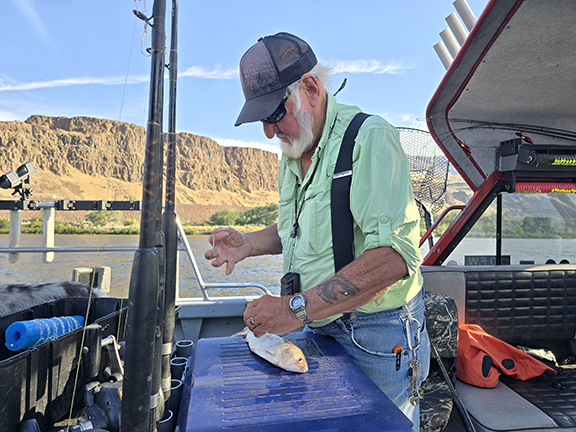
His Australian shepherd, “Girlie,” lay comfortably in the backseat; she would be our boat’s first mate and occasional source of entertainment.
After introductions, Touché invited Roy and I into his truck so we could get to know one another.
Our guide wore a green, short-sleeve fishing shirt, black suspenders were clasped to his blue jeans, and a carabiner held an assortment of keys. Touché’s bear-paw hands and thick fingers supported a boxed gold ring with a center ruby, and a silver watch wrapped shining on his left wrist.
“We’ll get into them,” Touché said of the sturgeon. “I have a bunch of fresh bait and they are all over the place.”
The modern Columbia River is a series of moving pools between dams throughout the entirety of her course through Oregon, Washington, and British Columbia, with the main tributary, the Snake River in Idaho, creating a huge network of reservoirs.
Our stretch with Touché was between John Day Dam and The Dalles Dam. Each stretch has white sturgeon that can be angled for year-round, although harvest is heavily restricted. White sturgeon under 54 inches in fork length may be taken from the water for quick photos; sturgeon larger than that may not be removed from the water.
Day 1
After breakfast in the café with Touché, we were soon on the water. Touché rigged giant Ugly Stik pool-cue fast-action casting rods with giant Penn level-wind reels and heavy, high-visibility braided line. Attached to the line was a sinker slide and weight, and a swivel was tied to the line. A heavy-braid 3-foot leader then led to a snelled “J” hook. On one setup, our guide dropped a squid – a bait choice that seemed peculiar for a freshwater river but one in which Touché had great belief. On the others, he baited the hook with a whole American shad or a chunk of cut shad.
Rigging an entire American shad is a sight to behold. The hook is passed back and forth through the upper half of the fish, creating “stitches,” until the head is reached and the hook is threaded through the skull with the hook point facing outward. The leader is cinched down with a half hitch loop over the tail to create a well-rigged bait that won’t easily fall off the hook, even if it’s picked at by small fish.
After just 20 minutes, the squid rod was dancing. The tip quivered up and down, then dashed backwards while the rod started to load.
“Go ahead and take it out of the holder and set it,” Touché said.
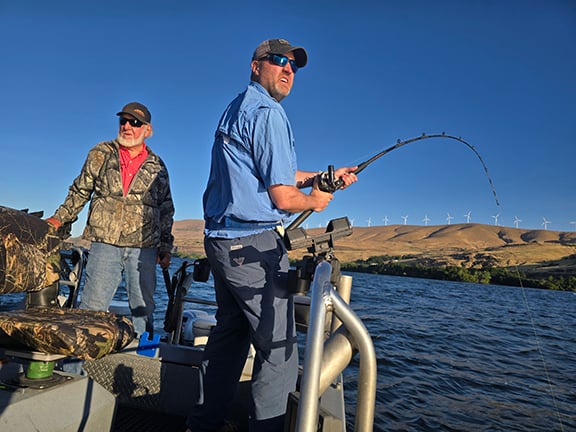
Following his instructions exactly, I was quickly feeling the power of an immense fish. Despite a tight drag, the fish kept taking and taking line, until I started thumbing the spool and eventually turned the fish in my direction.
“That’s how you can tell it’s a small fish – because he was able to stop it,” Touché said.
Twenty minutes later, we had the fish near the side of the boat and readied to take the hook out of a 5-foot-long white sturgeon.
If a small fish could wear me out, imagine the power of one much larger, I thought.
After resetting the squid rig, we sat down to wait for another fish.
“How old do you think I am?” Touché asked. Roy and I ventured guesses of 70 and 75. “I’m 85 years old,” he said with an air of pride. “I’ve outlived most of my friends.”
Roy and I were taken aback – not by the man’s appearance (he did look old), but rather by his seeming virility. Touché could get up and down from his chair, hop into his boat, climb over his bow-mount motor, and jump off his boat trailer as would a man 40 years younger.
“I just never slowed down. I love being out here too much,” he told us.
Meanwhile, the air had heated up, a breeze had ceased to blow, and John Day Dam all but stopped passing water. The bite had correspondingly slowed with the diminished flow. After some exploring and checking a few more fishing spots, we visited an island, passed through a bedrock neckdown, checked out some animal footprint pictographs, observed a few historical landmarks from a distance, and spot-hopped to end our day, picking up one more fish after the heat wave had become most oppressive.
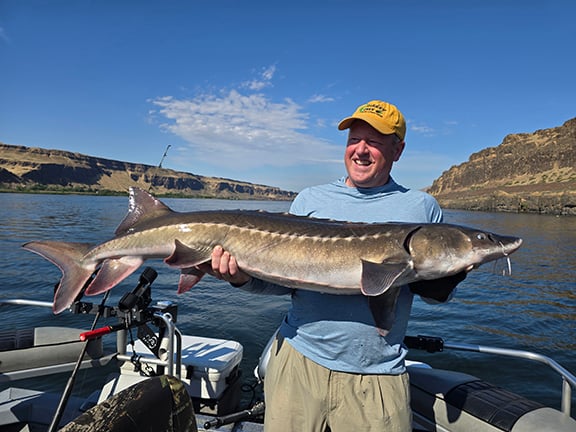
When the day of fishing had ended, Roy and I had tallied five white sturgeon, with the largest stretching to around 7 feet in length.
When our time to fish had come to an end, we raced back to the launch. Eventually we were on our way back into town.
There, Touché opened the shop where he stores his boat and invited us to sit down and enjoy a cold beer. And, upon being back on land and feeling the 106-degree heat, nothing sounded better.
After a while, a few locals popped in to ask about our day of fishing. The affable host, Touché offered them beers as well. A fellow guide was among them, and he and our guide compared notes about the day’s fishing. The conversation was complete with light-hearted jabs and similar banter – most of it by Touché, who touts the virtues of an enclosed-cabin boat to his peers, who insist on open layouts.
With a smile and a wink, he told the younger guide how we really enjoyed the day in the cabin’s shade and how we stayed cool with our plug-in fan. When the young guide changed topics – his wife wished to take him to a meeting to buy a camper – the sage Touché offered marital advice, his guidance less tongue-in-cheek than his riffs on boat layouts.
Before parting ways, we made plans to fish again in the morning. We’d meet an hour earlier to perhaps beat the heat and to ensure we had enough time to get back to the airport.
Day 2
Back on the water the next day, the wind was rocking and John Day Dam was dressed in the early morning sunlight in red, white, and blue lights to celebrate the forthcoming Independence Day holiday. Water was surging through the dam and our spirits were high.
Touché was not fooling around today.
“We’re going to put out big baits today to try to get a big fish,” he told us. “Today we’ll skip the squid and put out shad for big fish. We may not get numbers, but we should get size.”
Sounds good, we thought.
With baits out, the three of us watched the rods carefully. While we waited for a bite, Touché provided the entertainment. He had a lifetime of jokes to dispense – many of them the long-form variety that require proper delivery. A day earlier, he’d shared sausage, cheese, and tortilla chips. He’d shown us a photo album displaying the impressive catches of his clients over the years.
The Columbia River had become a destination for walleye anglers, because super-sized fish were produced decades after their introduction into the system. The photo album held years and years of photos of giant walleye catches, a few salmon, and some sturgeon.
The salmon, Touché said, were something for which he guided in his early years, but no longer. It’s not that he couldn’t catch salmon, he told us, but it was because it often would turn into “combat fishing” with other guides. Also, he said, walleyes just taste better. Of late, he said, about 90% of his clients want to chase walleyes, and about 10% want to chase sturgeon.
Some during our chatting, one of the rods started to load and we watched an epic takedown. The rod just kept pulling further and further back until Roy hopped up, pulled it out of the holder, and swept it backward as hard as he could.
But there was almost no give. The fish had headed downstream, and we knew this fish was different from the others we’d caught. Touché fired up the engines and we followed the fish, heading downstream, to the right bank, then to the left bank. …
Roy walked back and forth across the boat’s raised stern, keeping the line clear of the inboard jet motor intakes. After about 20 minutes, the guide and I just sat down and watched Roy sweat in the sun.
I decided Roy needed to be serenaded with some encouragement, so I turned on Bobby Bare’s “The Winner,” from 1976 – a crowd-pleaser for our trio and a symbolic song for a fish that would beat the heck out of Roy before he could declare victory.
Bobby finished his song before we got to see Roy’s fish.
But eventually the fish tired and was brought to the surface. It was an 8-foot-long behemoth of a white sturgeon. After boatside photos of the beautiful beast, we popped the hook and sent it on its way.
As Touché motored back to where we’d earlier anchored, we talked some more about life.
Touché told us he’d grown up in a large family on a farm in Ohio. When he was old enough, he’d enlisted in the U.S. Army. His service time happened to fall in between the Korean War and the Vietnam War. He was a member of the 101st Airborne – the “Screamin’ Eagles” – and he’d spent a lot of time at a base in California. He said he grew to love the West Coast, and he and some of his Army buddies stayed out West when his military service was complete.
Eventually he’d made his way to Oregon to visit an Army buddy. He never left.
“Touché, just how the heck did you get that name?” I finally asked him.
“I came upon it honestly,” he replied. When he was in the Army, his French girlfriend began to refer to him as Touché. The name stuck. His given name, he told us, was Alan Clark.
“If I answer the phone and someone asks for Alan Clark, I know it’s the cops or the government and I’m not home,” he said with a grin.
Touché told us about surviving open-heart surgery a handful of years ago and how his doctor had told him he was lucky to be alive.
He told us about traveling the American West and Alaska and the wonderful hunting and fishing trips he’s had in a lifetime. About how he met Kathee and raised a son and a daughter, and the blessings of his many grandchildren. How he fixed vehicles broken down on old, rutted-up logging roads in the middle of nowhere while he worked as a mechanic for the U.S. Forest Service.
He told us how one day, he decided that he was enjoying the fishing thing so much that he figured he ought to do it for a job. That day was in 1985, and he’s been a Columbia River guide ever since.
“So you guys just decided you wanted to go sturgeon fishing out of the blue and you called me?” he asked.
“Yep. You’re helping us take it off our bucket lists,” I told him.
We fished away the remainder of the day, landing four more fish, but none of them exceeding Roy’s 8-footer.
Spending time with Touché was a reminder to me that it’s not the years in your life, but the life in your years. In half a lifetime of guiding on the Columbia, Touché had found purpose, built friendships, and developed an entire community of support. His photo and “Fly by Nyte” moniker for his guide service hangs with his telephone number in the entrance to the local café, where the servers all know he’ll want his usual order each morning.
And if his clients don’t want the homemade pie in their prepared lunches, he’ll happily eat it. They’re paying for it anyway, he says.
At day’s end, we motored back to the access. Roy and I were more than satisfied with 10 big white sturgeon during a couple of days of fishing. It was an experience like no other – 4-, 5-, 6-, 7-, and even 8-foot-long fish towing us around without a care, eventually coming up for a photo, then returning to the bottom of the Columbia River.
We visited Touché’s shop for one more beer. While sipping those beers, we ogled photos from Alaska of giant halibut and salmon, a trio of giant elk heads from elsewhere in Oregon, and enough fishing gear to outfit the 101st Airborne.
There was a sign hanging by the shop door that summed up Touché’s life, I thought – a famous quote from Hunter S. Thompson. “Life should not be a journey to the grave with the intention of arriving safely in a pretty and well-preserved body, but rather to skid in broadside in a cloud of smoke, thoroughly used up, totally worn out, and loudly proclaiming ‘Wow! What a ride!’”
Great advice, and a reminder of the importance of all of our bucket lists.
Ralph Loos: Michigan’s reliable hunting traditions got an update (upgrade?) this season
More than any other collection of like-minded individuals, hunters tend to get stuck in their ways — and I say

Findlay Reservoirs support walleyes and saugeyes in northwest Ohio
An angler could do much worse than the pair of reservoirs at Findlay in northwest Ohio.
The latest offering
Ohio’s Outdoor Calendar
A look at upcoming outdoor-related events from across Ohio published in the Sept. 22, 2026 edition of Outdoor News.
