




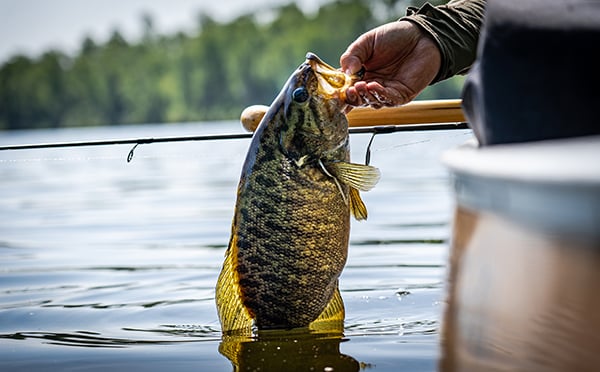
Outdoor News may earn revenue from products shown on this page by participating in affiliate programs. Click here to learn more.
From my first Boundary Waters Canoe Area Wilderness trip when I was in fifth grade to my latest, there have been two constants that seem to be inescapable: I will never find peace or enjoyment in washing camp dishes in the backcountry, and that none of my paddling companions will like to stay in one place for long.
As someone whose favorite part of the Boundary Waters is the incredible fishing, this can be frustrating. Every time I start to figure out a lake, we’re off to the next one. Be that as it may, doing 40- to 60-mile trips during long weekends has forced me to fish when I can and make every cast count – all while placing a premium on packing as little gear as possible.
Maybe it’s because the fishing is so good, or maybe because I have a dialed-in system, but I now know that it is undoubtedly possible to travel hard and fish well at the same time on a canoe trip. Here’s how.

Get good at trolling
Everybody knows that trolling is an excellent way to cover water and catch fish, but when there are a lot of miles ahead before your next campsite, sometimes the burden of messing with a fishing rod is an unwelcome task. Two things can ruin the momentum of a travel day when you’re trolling: getting snagged and not having enough space to paddle smoothly.
To reduce the frequency of these issues, I like to troll a crankbait that runs shallower than the depth we’re paddling. For example, if we’re averaging 10 feet of water, I’ll troll a small to medium floating crankbait that likely maxes out at 4 or 5 feet, even at trolling speeds.
You’ll catch fewer fish than if you were near the bottom, but you stand an excellent chance of hooking something every time you pass over humps, weedbeds, or suspended fish – while getting a quarter of the snags.
If I’m in the back of the canoe, I run the rod across both gunwales about 3 feet in front of my body so I can make a full paddle stroke without bumping it. If I’m in the front, I position the rod horizontally to one side, using my knee to keep it from pulling backward. As you encounter deeper or shallower water, adjust accordingly.

Bring reliable, simple lures
One of the best pieces of fishing advice I’ve ever read was from Michael Furtman’s “Boundary Waters and Quetico Fishing Guide.” He writes: “If your tackle box has handles, you have too much stuff.”
Considering the frequency, ruggedness, and difficulty of many Boundary Waters portages, carrying extra gear is a luxury you don’t have.
I like to bring a simple tackle tray with a few of each north-country staple: Rapala Shad Rap, Rapala Original Floating Minnow, a selection of ⅛- and ¼-ounce jigs, some Northland Whistler Jigs, a Rapala Skitter Pop, a Ziploc of plastic grubs and paddletails, and a slip bobber or two.
Leeches the easy way
I used to avoid live bait on long canoe trips at all costs. To me, there’s already enough to worry about, and keeping bait alive wasn’t a priority.
That was until Steve Renneberg, owner of Arrowhead Outdoors in Ely, taught me a trick for packing leeches into the backcountry with almost no additional weight or space. Instead of packing in a “leech locker” or bait bucket, I buy a tiny 8-ounce bottle of apple juice at the store, wash it out, and fill it with up to three dozen leeches. Simply replace the water a couple of times a day and keep it out of direct sunlight.
This way, as the sun is going down at camp and you’re finishing up chores, you’ve got a bobber out during prime time.
What’s the perfect archery release? Get the most out of your release aid
P.J. Reilly has likely shot as many release aids as almost anybody in the archery world.
Now in his
WI Daily Update: FFS shows us some fish just don’t want to bite
Forward-facing sonar has shown anglers that there are walleyes in shallow water even in the dead of summer. Tim Lesmeister

Episode 604 – Retiring MN DNR fisheries chief Brad Parsons, “What3Words” app, sharp-tailed grouse
Brad Parsons recently announced his retirement from the Minnesota Department of Natural Resources fisheries division effective this September, and he
