




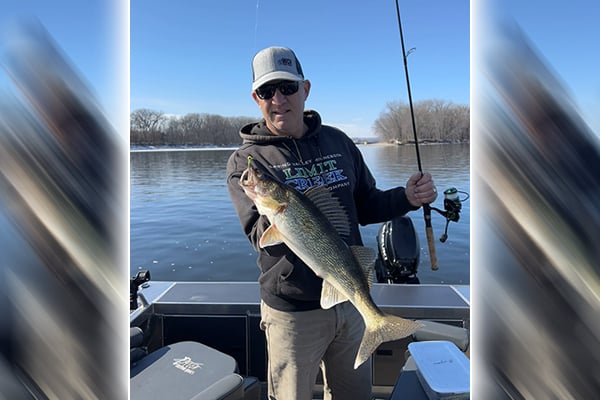
With its deep channels, red-and-green buoys swaying in the current, barges and bald eagles… if there ever was a real river, it’s the Mississippi.
A real river is one with calm and clear winter waters part of the year, then spring floods pumping out chocolate milk. A real river can change and float boats up into flooded trees or be low enough to dig your prop thick into a newly found sandbar. A real river is also loaded with walleyes, saugers, catfish, crappies, and northern pike.
Being both a fishing nut and student in the college of “what’s taking place around?” me for 27 years, I can tell you that February to April is the most fascinating time of the year on this Minnesota-Wisconsin border water. The Mississippi captivates me as it exits winter into spring life.
Captivated because I am eager to fish places that have produced great catches, and I’m confident walleyes will show up there again because they are driven by biology – the need to spawn.
Every year I bank on location predictability, because fish are much more instinctive than reasoning. They never conclude, “No, I’m not going to spawn this year… I don’t have that gusto of my youth, I think I’ll sit this one out!”
MORE FISHING FEATURES FROM OUTDOOR NEWS:
Month of March means trophy walleyes after ice out on Michigan rivers
Burbot through the ice are late winter’s overlooked opportunity
Cold water, big fish: Michigan trip after ice out results in that elusive 10-pound walleye
The predictable aspect is how walleyes and sauger will journey from wintering to spawning grounds, even though it is a long journey from the deepest parts of Mississippi River pools migrating upstream to spawn; telemetry studies show distances of 20 to 45 miles to reach the spawning grounds. But from an angling perspective, fish don’t travel all at once in a straight shot from point A wintering grounds to point B spawning beds. They stage.
Stage is a great word to describe walleye and saugers because when they spawn, they already have made the journey from area to area, staging, and waiting for the right environmental conditions of water temps or day length before each to move.

Winter transition
So, what’s happening now?
We are in winter transition, a period well before ice-out on inland lakes, with the river bays and slow sloughs iced up, but the channels are not. Huge river “lakes” like Pepin and Onalaska are iced-over. The winter transition season that takes place in late February to early March is its own season – one which exists before the prespawn.
Right now, the fish make smaller moves toward the spawning grounds, but largely stay back and stage before the “run.” Walleye and sauger still relate to the deep of the winter and swim in the deepest holes or areas of higher flow.
Flow rates from one end of the pool to the other are not the same; flow differs from local to local.
Prespawn
Soon, around mid-March, the river sees ice-out with bays and slower sloughs breaking up and the main channel free. This is the prespawn season when the fish “run.”
Walleyes and saugers move upstream in noticeable numbers triggered by rising waters and a warming trend. Fish move differing distances; some move further into the upper reaches of the pools near dams and tributaries. Others move less.
If the tributaries of the Mississippi are deep enough the ’eyes will enter. Many spawning tributaries though are shallow trout streams, and here fish will stay in the main river staging before the spawn, especially if the water is unseasonably low.
After they run and arrive in the northern reaches of the pools, if the flow is not too fast they still like the deep holes. They stack in such strong numbers that fishing in not-so-secret spots like tailrace water created by the dams can be good for all. The trick here is when they arrive versus where they will locate!
Spawn
Finally, the spawn season normally runs from early to mid-April. Only shallow southern inland lakes are clear from ice, but the river is ice-free. Now the waters have risen, and the flow is strong. Avoid the prespawn holes and search for slower-water seams farther downstream.
Both river and lake eyes spawn on areas that are rock-rubble, gravel, or mussel bed substrates. River ’eyes, like their close relative the yellow perch, can spawn on many diverse types of substrates. Some use flooded, off-channel habitats with timber, and canary grass either in a tributary or bays. Other river spawning areas coincide with cobble bottoms in side channels, and some use wing dams near spawning grounds.
Curve balls
Though we generally can count on the predictable nature of the spawn, X-factor changes can throw off anglers – like when the water rises, the flow increases, or cold fronts come to town. It still is after all, a transition season, so expect the unexpected!
The Mississippi River is an incredible, arguably underutilized resource from Prescott, Wis., south to the Iowa border. There is a continuous open season for walleyes and sauger, so when inland walleyes are off-limits, a short trip to the Minnesota-Wisconsin border still can produce some fillets.
If you’re an avid angler or simply a student of watching nature’s cycles, grab a jig and minnow, head down to the Mississippi River and see it all for yourself.
Editor’s note: The best way to reach the author’s guide service is through www.croixsippi.com.
Minnesota duck hunters await fresh birds as warm weather lingers
If you spoke with enough waterfowlers and waterfowl managers across Minnesota in the last handful of days, the message you
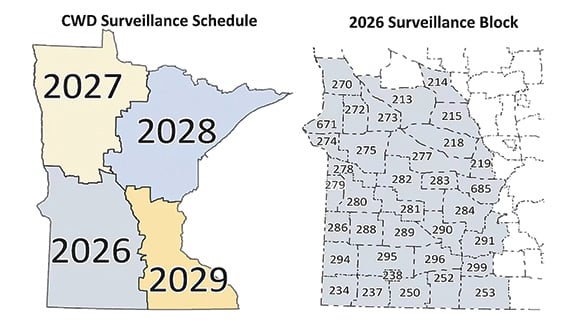
Minnesota DNR reminds firearms deer hunters to prepare for CWD sampling
Sampling is mandatory for southwest Minnesota the opening weekend of firearms deer season Nov. 7-8

Short on walleyes, but long on muskies: Beers Lake in Minnesota’s Otter Tail County
Otter Tail County’s Beers Lake is an excellent walleye fishery – nope. Beers is loaded with good-sized panfish and northern
