




Michigan Mixed Bag: NRC monthly meetings to be livestreamed

Lansing — DNR plans to livestream meetings of the Michigan Natural Resources Commission (NRC) in an effort to make it easier for the public to learn about the work of the commission and stay engaged on topics of interest.
Those interested in viewing the meetings do not need to have Zoom installed on a computer or mobile device in order to livestream the NRC meeting, according to DNR.
The first livestreamed meeting was held Feb. 11. NRC meetings take place monthly throughout the year. The majority are hosted in the greater Lansing area, but efforts are made to routinely travel to the Upper Peninsula, the northern Lower Peninsula and other regions.
The NRC is a seven-member public body whose members are appointed by the governor, subject to the advice and consent of the Senate. The commission has exclusive authority to regulate the taking of game and sport fish and is authorized to designate Michigan game species. Before each meeting, a draft meeting agenda will be mades available online.
Learn more by visiting Michigan.gov/NRC.
MORE COVERAGE FROM MICHIGAN OUTDOOR NEWS:
Deer baiting legislation clears Michigan House
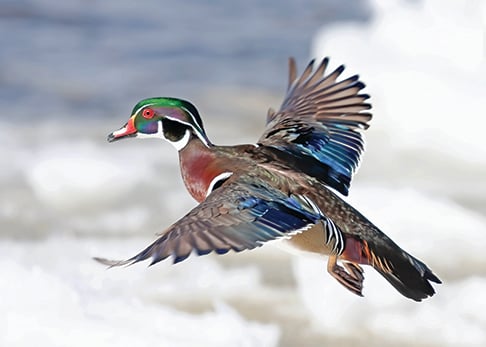
Ralph Loos: As woodies return to Michigan, let’s remember our key role in duck’s rebound
Iron County bear among oldest ever harvested in Michigan
CPOs Had Contact with More Than 750 Snowmobiles During Annual Race
Sault Ste. Marie — Michigan DNR conservation officers patrolled over 425 miles of snowmobile trails surrounding the 57th annual International-500 snowmobile race, which took place earlier this month in Sault Ste. Marie.
From Feb. 5 through the night of Feb. 7, conservation officers contacted over 750 snowmobile operators on the surrounding trails and roadways, encountering out-of-state riders from: Florida, Illinois, Indiana, Iowa, Minnesota, Missouri, Ohio, Pennsylvania, West Virginia, Wisconsin, Wyoming and Ontario.
According to DNR, officers focused their efforts on the DNR’s Ride Right snowmobile and ORV safety campaign – which promotes operating at a safe speed, sober and riding on the right side of the trail.
There were no major incidents reported on the surrounding trails during the enhanced patrols. Officers issued 44 citations and 97 verbal warnings for various violations. COs also assisted the Chippewa County Sheriff’s Department successfully locate a missing snowmobiler, and lodge one individual in the Chippewa County Jail for fleeing and eluding an officer, a felony offense.
Wolf-Moose Foundation Launches Nonprofit
Houghton, Mich. — Supporters of the world’s longest-running predator-prey study on Isle Royale have launched a new nonprofit foundation and aim to raise $2.2 million to protect the research from uncertain government funding. The Wolf-Moose Foundation wants to build an endowment that would permanently support the decades-long wolf-moose study on Michigan’s Isle Royale National Park.
The wolf-moose study includes the winter population surveys and the summer “Moosewatch” program, when experienced off-trail hikers trek through Isle Royale’s boreal forest to collect moose bones from wolf kills. The research began in 1958 and is considered the longest continuous study of any predator-prey relationship in the world. The project has made the remote Lake Superior island a global center for wildlife ecology researchers.
Michigan DNR acquires Black River Ranch
Lansing — The Michigan DNR has purchased the Black River Ranch from a privately owned hunting club in an $18 million deal. The acquisition includes more than 8,000 acres of land located in the Pigeon River State Forest. The Little Traverse Conservancy, one of the donors involved, highlighted the significance of the purchase for wildlife such as elk, black bears, and bobcats.
“That functions as a huge block of habitat,” said Kieran Fleming, executive director at Little Traverse Conservancy. “And so, you only get so many opportunities to add to that or to sort of shine it up for the future. We got so lucky, so many things came together at once that we could make it happen. But in the future of the state of Michigan, people will always be able to use this property for hundreds and hundreds of years.”
Michigan DNR says the purchase aims to protect the land, wildlife, and habitats, and was made possible with the support of several conservancies and wildlife foundations.
Cornell’s 20-Year Study: Deer Inhibit Trees but Tend to Raise Overall Plant Diversity
Ithaca, NY. — At high densities, white-tailed deer inhibit growth of trees but increase the overall diversity of smaller plant and weed species, according to a long-term study by Cornell University.
Twenty years ago, Cornell researchers established experimental plots meant to mimic abandoned agricultural land on university-owned parcels. Half of the plots were surrounded by fencing that excludes deer, and half were left open.
“All six of our plots where deer have been excluded by fencing have trees in them now, and in our open plots that deer can access, we have almost no visible trees,” said Anurag Agrawal, study co-author and the James A. Perkins Professor of Environmental Studies.
“Deer prefer woody things and often forage in the wintertime and eat woody stems. So even small saplings are not persisting.”
While the researchers found that deer inhibit forest growth, they also found that the presence of deer increases the overall diversity of smaller plant species.
SUBSCRIBER CONTENT
Read this article now.
Create a free Outdoor News account.
Create a free account below to get instant access to this article, thousands of Outdoor News stories, and our digital editions. Your 1-month trial starts the moment you sign up.
No credit card required
No credit card required
Subscriber? Login Here.
Share on Social
Hand-Picked For You
H2Ohio wetland to benefit St. Marys
USFWS announces new duck season framework process
Making sense of this year’s waterfowl report for Ohio hunters
Nine Ohio DND Division of Wildlife officer cadets training
Ohio Mixed Bag: State finishes up wetland project in St. Marys on Ottawa River
Ohio Letters to the Editor: Missing all of the old-school traditions of the fall season
Related Articles

Ohio Cuffs & Collars: Stolen black walnut tree from Wallace O’Dowd Wildlife Area
Ohio cuffs and collars are field reports from the Division of Wildlife. These reports are from the Sept. 25, 2026
H2Ohio wetland to benefit St. Marys
As part of Ohio Gov. Mike DeWine’s H2Ohio Initiative, the Ohio DNR (ODNR) and the city of St. Marys held
USFWS announces new duck season framework process
The Department of the Interior recently announced that the U.S. Fish and Wildlife Service (USFWS) is finalizing a streamlined process
