




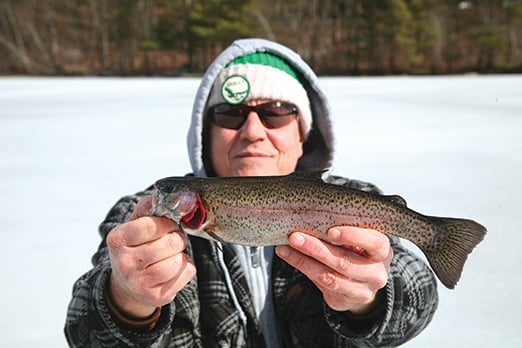
A cold and clear morning awaited us as we rolled out of our camp beds in Pennsylvania’s Potter County. The porch-post thermometer read minus 5.
As we arrived at Lyman Lake, after a hearty breakfast of course, the surrounding mountains were bathed in a warm winter sunlight. But within two hours, by 10:30 a.m., the hills were shrouded by heavy snow clouds.
As the wind and snow whipped our positions on the ice, I decided to give up – but not before landing three of Lyman’s fine trout, then struggling, really struggling, to return to my truck.
I got back to camp and not far behind me were my three friends, most of them with their own trout limits.
With a little huffing and puffing we plopped down on the chairs and sofa in the cabin, momentarily exhausted but smiling.
“Another fine morning for trout fishing on the ice,” someone with a beard full of melting ice crystals said. “I wouldn’t trade it for anything.”
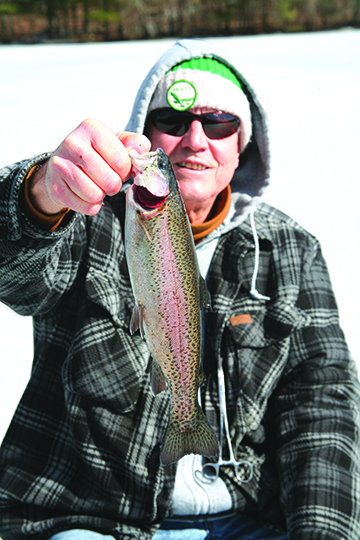
When you tell some folks that you’re going trout fishing at the height of winter you get two responses: “Is it safe?” and, “Do trout really hit when it’s that cold?”
The answer to the first question is: I don’t go onto an open lake without a frozen sheet of at least 4 inches. I may hit a backwater cove with somewhat less but you don’t find trout in backwater coves at this time of year. I do find bluegills, bass and pickerel in those spots but that’s another story.
The answer to the viability question is a definite, “yes” but you have to understand that trout under the ice are a different animal.
Most anglers expect trout to be feeding in riffles, lurking behind rocks and sometimes rising to the surface to take a floating bug. Obviously, that’s not the case under the ice. In an icy condition, trout form schools of varying numbers, from a few to many, and circulate around a lake feeding as they go.
When ice fishing, there are periods, also of varying degree, when you won’t get a bite (or see a fish on your sonar) and then you, and other anglers around you, will experience a flurry of action.
At smaller impoundments like Antietam Lake, outside Reading, I have actually timed the return of a pod to my position with a degree of accuracy – of course depending on how the trout are biting that day.
On a good day it takes Antietam trout between 20 and 30 minutes to go around the elliptical portion of the lake. That’s just crazy but mostly true.
MORE TROUT COVERAGE FROM OUTDOOR NEWS:
Winter trout-fishing options are ample across Minnesota
Commentary: It’s time to remove the Imperial Dam on New York’s Saranac River
When the water finally hardens in Pennsylvania, it’s trout time
When ice fishing wider Minsi Lake in Northampton County, I never know when a school will show up but there’s also a definite circulation.
On very small impoundments, such as Deep Creek Lake in Montgomery County, trout movement patterns are harder to decipher because the fish may be in a constant state of travel. A lot depends on the structure or construction of a lake.
Because, for example, Antietam is mostly a round bowl, Deep Creek is variably flat with a distinct channel and Lyman is a bit like a model railroad line, a definitive oval around the lower end of the lake.
The point is, trout adopt to the idiosyncrasies of each impoundment, and if you learn to read and anticipate these idiosyncrasies, you’re success will be pleasantly affected.
For instance, I’ve seen anglers, with a trout or two to their name, get discouraged by a period of inactivity and pick up sticks while I’m thinking, “just give it time boys (or girls). They’ll be back.”
No other ice fish have such a predictable travel route, though bluegills and bass often pod up and travel about. However, there’s no timing or route to the grouping of bluegills or bass – though I often expect a pod of pickerel to appear around rocks and weedbeds in the late afternoon or early evening, depending on sunset times.
When ice fishing for trout, it really pays to employ a couple of deadsticks near your position. Propping the rods up, in whatever way you fashion your deadsticks, place the dangling lure/bait at staggered depths.
Actively fishing one jigging stick and employing one tip-up, I’ll stagger my rod at 2 feet below the ice sheet itself, then another 5 feet down, then another a foot or so above the bottom.
These are round numbers, of course. My active rod is worked anywhere in between, and I closely monitor the sonar to adjust that depth with the appearance of signals on the screen.
When a blot of red shows up on the sonar, meaning a pod is coming through, I don’t put my lure/bait right in their faces but instead keep it above them a foot or so. Trout like rising to the offering no matter what the season. Rarely do I see them going down to take an ice bait. Don’t know why, they just rarely do.
Timing and depth deciding is all part of the fun of winter trout fishing, and I truly love it – even if a storm blows me off the ice.

Fall is the perfect time to catch Lake Erie’s giant walleyes; here’s what to focus on
Anglers who are prepared to face some colder weather can catch lunker walleyes. For the past decade, walleye fishing derbies
Upper Peninsula landowner provides evidence feral pigs have established there
A population of feral pigs that escaped from a game farm have become established in southern Marquette County, based on
Big waterfront project in Lorain, Ohio, to benefit anglers
When the Hot Waters Boat Launch reopened in the City of Lorain on May 22, it was just one milestone
