





So you’ve been sitting on the fence about diving a bit deeper into this ice fishing thing. Or, you’ve been at it a while and haven’t experienced the success you’d anticipated.
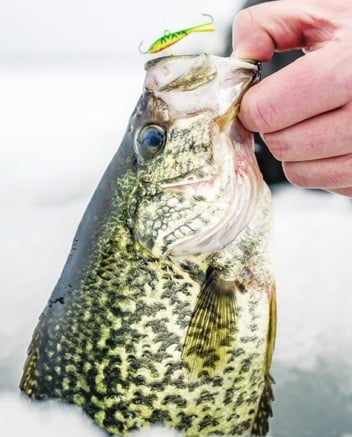 Regardless of your status – a relative newcomer or someone looking to up your game – there are numerous ways to find the right path to becoming a more productive hard-water angler.
These aren’t mind-blowing or cutting-edge techniques and suggestions. Just simple ways to tune up the process and achieve better outcomes.
Be prepared before you think about drilling a hole
In any endeavor, preparation is the key to success, and that rule applies to catching fish through the ice, too.
Before you even consider setting foot on a frozen lake, make sure your gear is ready to go and working properly.
Again, little things can make a difference. Check your rod guides for abrasions, make sure your reels are functioning smoothly, eliminate holes in your canvas shelter, and sharpen auger blades. Are batteries holding a charge? Electronics running properly?
These are just some examples, but you get the idea.
Ensure all of your equipment is ready for rugged ice use.
Winter success = mobility
The opportunity to be a mobile angler during the hard-water season is arguably the most important factor. Your willingness and ability to move on a moment’s notice will tip the odds in your favor.
When you’re in a boat, you don’t sit in the same spot all day. You move until you find fish, so adapt that strategy to the ice fishing season, too. Yes, it’s more work on the ice, but less painful than you might expect. Here’s how:
• You don’t have to bring every piece of ice fishing equipment you own onto the lake.
If you want to move around, don’t weigh yourself down with an arsenal of unnecessary gear.
• Grab a couple of rods and reels for the species you’re targeting, your electronics, auger, just enough tackle to fit in a pocket-sized box, bait, and the lightest shelter and heating unit you can afford. Stay light.
• Don’t overdress and don’t under dress for the conditions on a given day. This is a highly active spot-to-spot or hole-hopping situation, so dress to stay warm, but avoid breaking a serious sweat.
The value of electronics
Modern electronics make you a better ice angler and are the most important tool you’ll carry onto the ice.
They eliminate guesswork by providing a look at what’s below your feet.
You’ll see how fish are reacting, the type of structure they’re working,
and more details that would otherwise go unseen without some form of
electronics.
There’s no longer a reason to fish blind, and you don’t have to spend small
fortune for underwater eyes. There are plenty of flashers, underwater
cameras, GPS systems, or units that combine multiple options – many are
reasonably priced.
Gather some information
You can own all the right equipment and be the most
mobile ice angler ever, but you still won’t put many fish topside if you
don’t understand the system you’re working.
Research a lake before leaving home. Look at maps to determine where to begin
and locate structure. Go online, talk to a local angler, or chat up a
nearby bait shop. Bottom line: Gather as much intel as possible before
you head out.
Developing a starting point builds confidence. You shouldn’t have to start the
entire fish-locating process from scratch, especially with the tools now
available.
Test your presentations
A stubborn ice angler is usually not the most successful ice angler. Exit your comfort zone once in a while and
experiment. What they bit on last winter, yesterday, or even a few hours
earlier might not keep producing.
So change it up and play around with different presentations after
something else fails. Everyone has one or two confidence baits, but
don’t limit yourself to just them.
Subtle changes in color, size, weight, and shape make a huge difference. You
might have to go from glow to green, vertical to horizontal jigs, or
something bigger to smaller. But you won’t know what’s productive if
you’re too stubborn to figure it out.
Make the fish move
Fish sitting nearer the ice usually are more active. If they’re up, they’re
usually feeding more aggressively than those loafing on the bottom.
So work your presentation above the fish. It doesn’t matter if they’re
already suspended or tight to the bottom, if you can get them to move
up, they’ll usually eat.
This holds true for any fish species. Keep the bait above them and see what
reaction you get before you start pounding the bottom.
Understanding food, drought conditions for Minnesota’s Sept. 19 bow opener
Driving home at dusk after a quick scouting mission on Sept. 7, a huge buck and another younger buck made
Commentary: Walz executive order gives Boundary Waters the commonsense protections it needs
Some of my most-treasured memories are of hunting and fishing in the Boundary Waters Canoe Area Wilderness – and of
Where hunters can — and should — pursue antlerless deer in the Adirondacks
It was the last day of the late muzzleloading season in the Northern Zone, and therefore the very last big
