Myth America
In the outdoors, you just never know when you might run into a mythical creature, including a jackalope, mermaid or even Sasquatch.
Jacks or Better
In Douglas, Wyoming, seeing a mythical jackalope (half-antelope, half-jackrabbit) is commonplace, considering that a taxidermist from there is credited for creating the first whimsical creature nearly 74 years ago.
Douglas taxidermist Douglas Herrick is known for creating the first physical portrayal of the legendary jackalope in 1939 when he mounted antelope horns on a stuffed jackrabbit. The first jackalope was exhibited in the LaBonte Hotel in Douglas, and an eight-foot statue of the creature greets entrants to the Wyoming State Fair. A 13-foot silhouette of a jackalope also stands on a hillside near town.
While he never patented his idea, Herrick received a proclamation from Gov. Ed Herschler in 1985 naming Wyoming the animal’s home. In 2005, state lawmakers approved a measure naming the jackalope as the official mythical creature of Wyoming.
Hunters and tourists traveling through Douglas, Wyoming this fall were climbing all over themselves for the chance to get their pictures taken with a giant, furry jackalope, according to the Douglas Budget newspaper.
The 13-foot jackrabbit with antelope horns was originally part of a parade float during the summer’s Wyoming State Fair. After the fair, it traveled to various locations around town, where businesses rented it for $100 a week from the Douglas Chamber of Commerce as a mobile tourism billboard.
In September and October, a 13-foot furry jackalope that appears at various businesses around the town as part of a promotion is a particularly big attraction for hunters visiting the Cowboy State from other parts of the U.S. It’s reported that sportsmen are seen straddling the beast for a photo-op almost any time of the day or night.
“I was driving by it a few weeks ago and there was a woman in lingerie riding on top of it while some guy below was taking pictures,” said Casper Star-Tribune correspondent Rena Delbridge of Douglas.
Noting that beauty—like art and humor—is subjective, Delbridge added, “She wasn’t really the type of woman you’d want to see in lingerie.”
Mr. Herrick died in January 2003.
NOAA Pours Cold Water on Mermaids
The National Oceanic and Atmospheric Administration (NOAA), a federal agency charged with a myriad responsibilities ranging from weather satellites and marine fisheries to aquatic research and hurricane tracking, recently weighed-in on the question of the existence of mythical mermaids.
An NOAA online response appearing in late June was apparently sparked by public reaction to a recent faux-documentary, “Mermaids: The Body Found,” which aired on Animal Planet (a Discovery Channel affiliate), which suggested there was historic evidence of mermaids.
The docu-drama “paint(ed) a wildly convincing picture of the existence of mermaids, what they may look like, and why they’ve stayed hidden...until now,” according to the show’s press webpage.
Despite the fact that the show’s producers acknowledged it was science fiction, many viewers evidently found it “wildly convincing.” Utilizing an “X-Files” mix of state-of-the-art computer-generated animation, historical fact, conspiracy theory along with real and fictional footage, there was enough real science to make it seem plausible—at least to some more gullible viewers.
A statement posted last week on the NOAA website titled “No Evidence of Aquatic Humanoids Has Ever Been Found,” noted:
“The belief in mermaids may have arisen at the very dawn of our species. Magical female figures first appear in cave paintings in the late Paleolithic (Stone Age) period some 30,000 years ago, when modern humans gained dominion over the land and, presumably, began to sail the seas. Half-human creatures, called chimeras, also abound in mythology—in addition to mermaids, there were wise centaurs, wild satyrs, and frightful minotaurs, to name but a few.”
Interstate Sighting: Wolf and Bigfoot
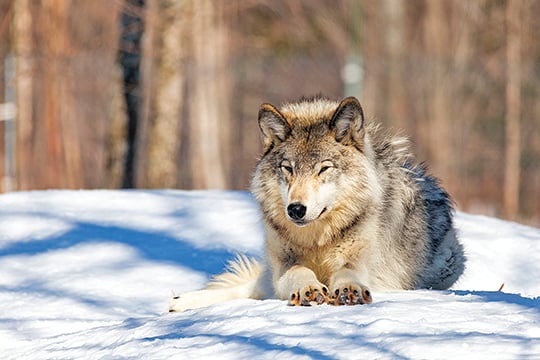
One species was recently removed from the federal endangered species list, while the other has never been recognized as a species by the U.S. Fish & Wildlife Service--or any other wildlife or scientific agency, for that matter.
Yet the gray wolf and Sasquatch were recently identified in separate sightings just a few miles apart on the same interstate highway in Montana.
Authorities with the Montana Department of Transportation say a gray wolf carcass was found along Interstate 90 near the Idaho border. Montana Fish, Wildlife and Parks officials subsequently reported that the animal had injuries consistent with a vehicle collision. A few miles to the east, a motorist driving along I-90 near Alberton called 911 to report that he saw a Bigfoot approaching a couple fly-fishing on the Clark’s Fork River.
According to a report in The Missoulian, the motorist said the Sasquatch was more than 7 1/2 feet tall, with long arms, a skinny frame and brown hair.
But even the director of the Bigfoot Field Researchers Organization in California (oh yes, it’s a real organization) told the newspaper he believes the report is suspect.
“You can walk in the woods in Montana your whole life and never come across the remains of a mountain lion and they outnumber the Bigfoot 1,000 to one,” explained BFRO’s Matt Moneymaker.
A thousand to one? We don’t remember seeing the results of that study in the Journal of Wildlife Research.
Email
Print